The Continuity Error Myth: When a Mismatch Matters
Use a continuity error decision process to tell which mismatches confuse action, redirect attention, or deserve repair without sacrificing a stronger performance.
The same cut can make a moved glass invisible or make a character’s promise look false. A continuity error matters when it changes what viewers understand or pulls attention from the scene’s intended beat. Editors deciding whether to repair one should ask what the mismatch does in this particular cut.
That question is more useful than asking whether two frames match. A prop can shift between shots without changing the scene; a small change in a character’s position can alter who appears to have taken an object, noticed a threat, or ended a conversation.
What does the mismatch make the viewer infer?
Continuity is often treated as a visual ledger: the cup was here, the door was open, the actor turned left. But viewers do not track every detail equally. They use changes to infer action, attention, and time. A mismatch becomes consequential when it points toward an inference the scene did not intend.
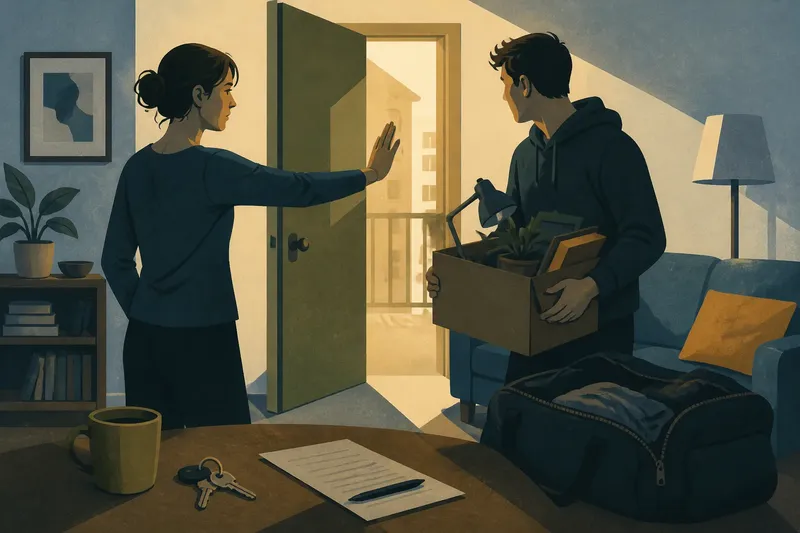
Imagine an invented scene in which a tenant hears a knock and hides a key under a blue bowl. The editor has two shots: in the close-up, the key is under the bowl; in the reverse shot, the key is visible beside it. If the tenant later reaches beneath the bowl, the discrepancy changes the apparent action and may make the character seem careless or the cut seem to skip a beat. The editor could use the close-up through the hiding motion, then cut to a shot that does not reveal the key’s position. The result should preserve the intended action, though it may cost some visual coverage.
Now imagine the same key remains in the background after the hiding action is over, with no later reference to it. Its placement may be visibly different but irrelevant to what the scene asks viewers to understand. The useful distinction is not “important object” versus “unimportant object.” It is whether the edit gives the detail a job.
How can you tell a meaningful mismatch from a distracting one?
Look at the moment around the cut, not at isolated frames. A viewer’s attention is already directed by movement, dialogue, eyelines, framing, and sound. A shift that occurs during a fast line may pass unnoticed; the same shift during a quiet pause can become the most active thing on screen.
Consider three different effects:
- Changed action: If a hand appears to release a key before the other shot shows the character still holding it, then the cut may confuse who controls the key. If control matters to the next beat, use a shot that makes the handoff clear; otherwise, keep the better-paced cut.
- Changed emphasis: If a close-up makes a note look deliberate and the next shot shows it turned away, then viewers may assume the note has been hidden or dismissed. If that inference is not intended, adjust the shot order or choose another take; if the note is incidental, leave it alone.
- Changed physical state: If a character’s coat is soaked in one shot and dry in the next during a continuous exchange, then the scene may appear to skip time. If no time jump is intended, look for a cut point or shot that masks the change; if the scene already signals a pause, the difference may support rather than disrupt that impression.
- Changed performance: If a prop shifts but the cut preserves a hesitant glance that carries the scene, then repairing the prop may cost the more meaningful beat. If the prop shift itself redirects attention, choose a different take or cover it with an alternate angle.
When should you repair a continuity error?
Repair when the mismatch confuses a physical action, creates an unintended story inference, or draws the eye at a moment meant for something else. A repair can mean more than matching the object exactly. It may mean changing the cut point, using another angle, adding an insert, or allowing a sound cue to carry the action while the image changes.
Strict matching matters most when the scene teaches viewers to track a detail. A key passed from one character to another, a wound shown in close-up, or a letter read aloud has been given a clear role. If its state changes without explanation, viewers may question the action or the story’s logic.
But a technically neat cut is not automatically a better cut. Suppose one take matches the sleeve and mug while the other gives the actor a more convincing moment of recognition. If the objects are incidental and the second performance makes the story clearer, preserving that reaction may be the better choice.
What should you check before choosing a repair?
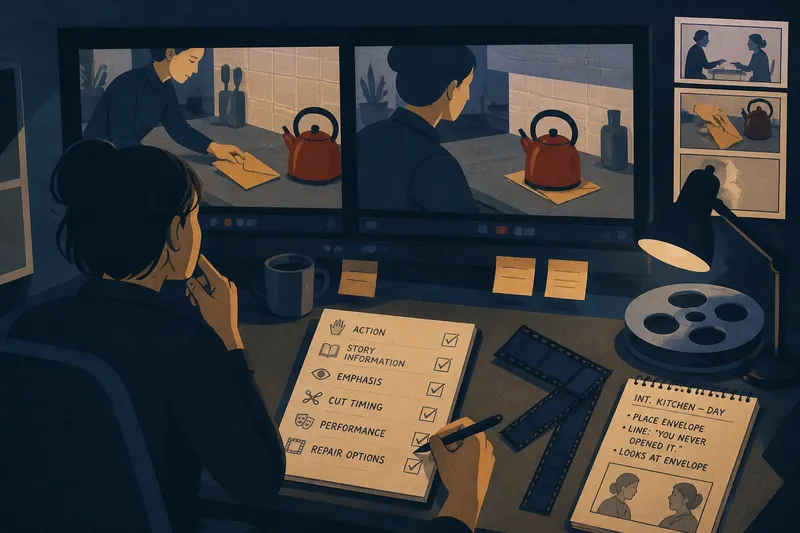
Use the following checks on the scene at normal speed. Each one points to a decision, not a demand to fix every difference.
- Action: Check whether a hand, prop, or body position changes across the cut. If that change obscures who did what, use a clearer take or cut point; if the action remains readable, keep the stronger shot.
- Story information: Check whether the detail affects a later line, reveal, or decision. If it does, match or conceal it; if it has no later consequence, leave it unless it distracts.
- Emphasis: Check whether framing, focus, dialogue, or a pause asks the viewer to notice the detail. If the scene emphasizes it, repair a contradictory change; if it stays peripheral, prioritize rhythm and performance.
- Cut timing: Check whether the change coincides with a sharp movement or a still pause. If it lands in a quiet, exposed moment, try another cut point or angle; if surrounding action naturally draws the eye elsewhere, compare the edit in context before intervening.
- Performance: Check what the matching take costs in expression, timing, or line delivery. If the cost weakens the intended beat and the mismatch is harmless, keep the performance; if both the mismatch and the performance issue are noticeable, seek different coverage.
- Repair options: Check whether another take, insert, reaction shot, or sound bridge is available. If an option hides the problem without obscuring action, use it; if it introduces a new jump or dulls the scene, retain the least distracting version.
Say you are editing an invented exchange in a kitchen. The first shot shows a character placing a sealed envelope beside a red kettle; the reverse angle shows it partly under the kettle. The next line is, “You never opened it,” and the other character looks directly at the envelope. First, check the action: the placement is visible, so the changing position could imply that someone moved it. Next, check story information: the envelope matters because the dialogue refers to whether it was opened. Then check emphasis: the eyeline directs attention to it. Finally, compare the takes: one matches the envelope but has a flat reaction; the other gives a clear, uneasy pause. The decision is to keep the stronger reaction only if a cut point or alternate angle hides the position change. If no such coverage exists, use the matching take, because the envelope’s placement affects the accusation the scene is making.
Which continuity questions help with a difficult call?
Does every prop mismatch need a fix?
No. Fix a prop mismatch when it changes an action, alters story information, or keeps drawing attention away from the scene. If the object has no role in what viewers need to understand, its exact position may not matter.
Can a stronger performance outweigh exact matching?
Yes, when the mismatch does not confuse action or create a false inference. Keep the better reaction if the detail stays incidental; if the detail becomes conspicuous, look for another angle or cut point before choosing.
How do you judge whether viewers will notice?
Play the scene at normal speed with dialogue and sound intact, then watch for where attention goes. Frame-by-frame inspection can reveal a discrepancy, but it cannot tell you by itself whether the discrepancy disrupts the scene.
What if no take matches perfectly?
Choose the cut that best preserves clear action and the intended performance, then see whether another shot, insert, or sound bridge can soften the mismatch. If the repair creates a more confusing transition, keep the clearer original cut.
What should continuity protect?
Continuity should protect the scene’s chain of meaning: who acted, what changed, and what viewers are meant to notice. The same object can be essential in one cut and irrelevant in another because framing, dialogue, and action assign it different roles.
For a final continuity error decision, watch once without hunting for discrepancies and note what the scene makes you attend to. Then replay the specific cut. If the mismatch changes an inference or steals attention from the intended beat, repair it; if it only survives close inspection, the stronger performance or cleaner rhythm may deserve the cut.