Before the Studio Set: Where Early Films Found Their Backdrops
Early film location shooting paired real streets and landscapes with built scenery, helping productions shape a scene around access, framing, and control.
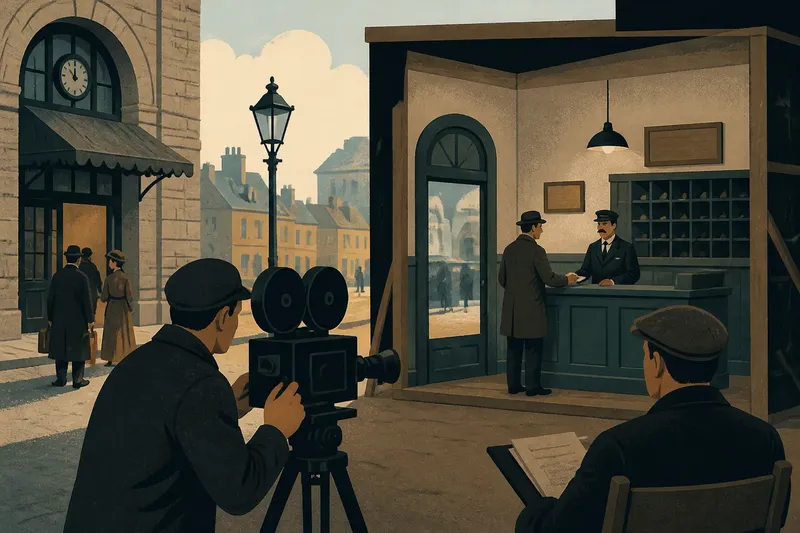
Early film location shooting could place a camera beside a street, factory, shoreline, or station, while a constructed backdrop brought a room—or an imagined landscape—within reach of the crew. These were not competing claims about truth. They were different ways to arrange a view, each with practical limits that depended on the camera, the scene, and the available space.
What did real locations give early filmmakers?
An existing place supplied surfaces and scale that a small production might not have built: a worn pavement, a public building, or a harbor opening toward the horizon. In early filmmaking, location work could also mean working with a relatively fixed camera and arranging the action within its view. The setting offered its own detail, but the camera still decided what the audience could see.
That did not make location shooting effortless. Crews needed access and had to bring performers and equipment to the site. Light and activity could change, while objects beyond the story’s needs might intrude into the frame. A real street was useful only if the production could position the camera and actors where the scene required.
Choosing a location was already a design decision. The crew selected a particular street, angle, and background, then shaped the action around them. The place existed before filming; the screen version did not.
Why put scenery behind the actors?
A painted backdrop or scenic flat could suggest a room, skyline, or distant landscape without requiring a crew to travel there or construct every feature in depth. The production arranged the visible portion for the camera and left unseen areas unfinished. Like a shop window, the display was made for a particular view, not for inspection from every side.
That approach offered control over entrances, props, and the actors’ positions. It also made the limits of the space consequential. A backdrop could look flat if its lighting and framing did not support the image. A wall that worked from one camera position might expose its edge if the camera moved.
A backdrop and a set are related but not identical. A backdrop is the background surface or image. A set is the prepared filming space, which may include walls, doors, props, and a backdrop, without being complete outside the frame.
How did camera placement shape the choice?
The camera turned a place into a usable image by including some details and excluding others. A wide view could show the depth of a real street or expose the edges of a constructed scene. A closer frame might remove distractions, but it could also lose the scale that made the location valuable.
Actors’ movement posed a similar problem. On a set, a crossing or turn could reveal that a wall was shallow or that an entrance existed only where the camera needed it. At a location, performers might have more room but also face obstacles irrelevant to the story. Blocking had to fit the space actually available.
Background activity could compete with the main action. A genuine street might offer convincing texture but pull attention away from the performers. A painted view could simplify the frame, yet look conspicuously tidy. The image depended on the relationship among scenery, light, framing, and performance, not on whether the setting was built or found.
How could a production combine locations and backdrops?
A scene could use a real exterior to establish a place, then shift to a constructed interior for dialogue or movement that needed more control. The edit connected the two through visual cues such as a doorway, sign, or matching colors. This did not make either image more truthful; it let each part of the scene use the space suited to its job.
Say a small production needs a clerk to leave a station and meet a traveler. The starting inputs are a real station entrance, a nearby street with passersby, and a ticket-counter exchange that must be heard and framed without that activity. The crew films the entrance and the first meeting outside, then stages the counter exchange on a set with a matching station sign and doorway detail. The resulting cut can move from a recognizable exterior to a controlled interior; the tradeoff is that the visual details must match closely enough for the spaces to read as one station.
For a production choice, these observations can clarify the tradeoff:
- If the location offers a distinctive building or landscape that the scene needs to establish, then use its useful view; if access or sightlines obstruct the action, then use a limited exterior view or construct the needed portion.
- If changing light disrupts continuity between shots, then schedule the scene around a consistent condition; if the schedule cannot accommodate that, then move the action to a controllable interior.
- If public activity draws attention from the performers, then choose a quieter angle or time; if the activity remains intrusive, then stage the scene on a set.
- If actors need to cross through several entrances, then check that the location supports those paths; if it does not, then build only the walls and openings the camera needs.
- If a painted backdrop looks flat from the planned camera position, then adjust framing and light; if the visible edge still breaks the image, then use a more limited frame or a deeper constructed space.
- If the scene needs a view of a distant setting but no movement into it, then a painted backdrop may supply the image; if performers must interact with that space, then add physical scenery or choose a real location.
What questions clarify the production choice?
Does a real location always look more authentic?
No. A real place can distract or conflict with the scene, while a constructed space can feel coherent if its visible details and staging support the same idea of place. The material origin of the background does not settle how it reads.
Can one scene use both a location and a set?
Yes. A real exterior can establish the setting, with a set providing a controlled interior. Matching signs, colors, and entrances can help the edit connect the two.
When is a painted backdrop useful?
It can suggest a distant view without requiring a full environment in three dimensions. Its usefulness depends on the camera angle and whether the action exposes its edges or shallow depth.
How is a backdrop different from a set?
A backdrop is the image or surface behind the action. A set is the prepared space for filming and may include that background along with walls, entrances, and props.
How should viewers read an early film’s setting?
Ask what the setting contributes to the scene. It may establish a public place, give actors room to move, or supply a quiet background for a closer view. Then notice the frame’s boundaries: a cropped wall or doorway may reveal how much of the apparent world the production actually needed.
Early film location shooting and constructed scenery offered different kinds of control. A real place brought existing scale and irregular detail; a backdrop let the crew select what appeared behind the action. The distinction is useful because it shifts attention from whether a setting was “real” to what the production chose to make visible—and what it could leave just outside the frame.