One Take or Several? Choosing a Way to Direct a Conversation
One take or several for a film conversation? Choose coverage that makes a listener’s behavior, shifting power, or a change in the room clear on screen.

One take or several for a film conversation? The choice becomes concrete when an actor keeps talking while the other person folds a napkin into smaller and smaller squares. A single frame can preserve both actions as evidence. Separate coverage can make the listener’s hands, then the speaker’s face, the scene’s distinct points of attention. The directing question is not which method looks more refined. It is what the audience needs to compare, and when.
What should stay visible at the same time?
Read the dialogue aloud and mark each change in what the characters know, want, or are willing to show. Then look for actions that occur during someone else’s line: a hand moves toward a key, a listener turns toward the door, a speaker notices and changes course. These simultaneous events may carry more meaning than the spoken exchange alone.
A continuous frame lets viewers compare behavior without an edit separating it. That matters when the scene’s meaning lies in the difference between what one person says and what the other does. It also asks the director to compose carefully. If a glass hides the listener’s hands or the camera favors the speaker throughout, the shot may keep both actors in the frame while making only one of them readable.
Coverage can isolate a detail that a shared frame cannot make clear. A close view of a thumb rubbing a chipped mug may tell the audience that a character is losing composure, while a wider shot would leave the gesture too small. But an edit also changes the relationship between events: a reaction shown after a line feels selected, not merely present beside it.
When does a sustained take earn its place?
Use a sustained take when duration itself is part of the pressure. A pause may become uncomfortable because neither character ends it. A person may begin to answer, reconsider, and keep listening. Holding the shot allows the audience to watch that choice unfold rather than receive it as a highlighted reaction.
Blocking can make a gradual change legible. One character starts beside the exit and moves to the table; the other stays seated but turns a folder face down. The shift in distance and access becomes part of the exchange. The camera still needs a clear view of the behavior that matters. A long take is not automatically observant; it can simply preserve an unhelpful composition for longer.
Before choosing a moving shot, check its route against the performers’ eyelines, furniture, lighting, and sound. A dolly or handheld move should arrive where the important action can be seen, not merely where the camera can fit. If the camera must pass behind a performer during a crucial reaction, revise the path or choose a fixed composition. The audience cannot read a moment hidden by the crew’s elegant arrival.
When does separate coverage make the scene clearer?
Use separate shots when a small piece of information needs a clean visual landing. A character may recognize a name on a letter, notice a second cup on the table, or decide not to answer. A closer angle can establish that the detail registered without asking the audience to search a crowded frame.
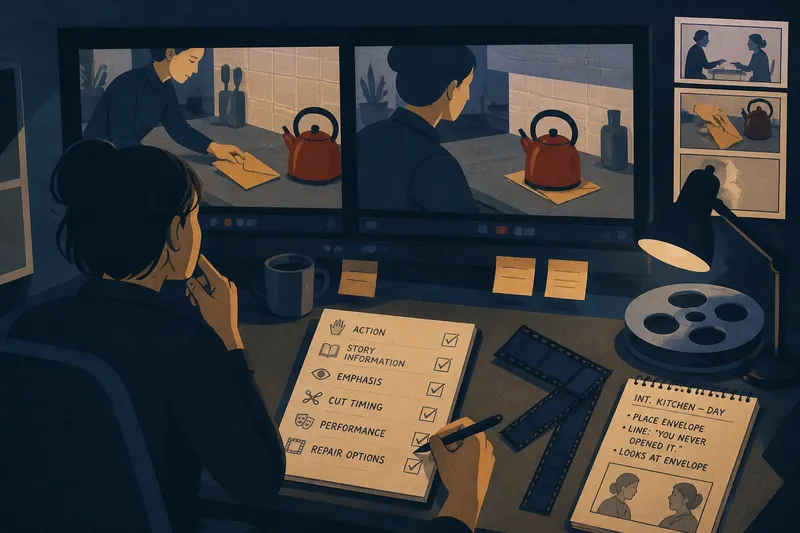
Coverage also lets the edit change the scene’s emphasis. A two-shot can establish an ordinary exchange, then a closer view can hold on the listener after a question. Staying with that face makes the silence part of the answer. Cutting back to the speaker at once would direct attention elsewhere.
Plan angles around dramatic decisions, not a habit of alternating whenever the speaker changes. A two-shot, selected singles, and a useful insert may be enough; each shot should solve a visibility or emphasis problem. If every line receives a fresh angle, the conversation can feel less like two people thinking and more like a clerk sorting paperwork into trays.
Which room details change the choice?
Ask what the setting does besides contain the actors. A doorway can offer an escape; a table can divide the characters; a window reflection can show someone watching without turning around. If a change in position affects who has access or control, keep enough of the room visible for that shift to make sense.
Practical constraints can alter the plan. A booth may prevent a reverse angle. A refrigerator may interfere with clean dialogue. A moving light reflection can call attention to a camera move that was meant to pass unnoticed. Walk the space with the actors, camera, and sound team, then decide which visual information is essential and which can be sacrificed without confusing the scene.
Say a director is staging an invented scene in a narrow laundromat: one character asks for a spare key while the other keeps watch on a turning dryer. The starting point is a shared conversation with a private distraction. First, the director blocks both actors in view and confirms that the dryer’s reflection does not hide either face. Next, they rehearse the request while the listener glances toward the machine. If that glance and the response need to be compared as they happen, the director keeps a two-shot; the expected result is that viewers can see the request and the divided attention together. If the decisive beat is the listener slipping the key beneath a folded towel, the director adds a closer angle on the hand; the expected result is that the concealment reads clearly, at the cost of briefly losing the other character’s face. The tradeoff is visibility versus simultaneity, not a contest between styles.
What should you check before choosing coverage?
Can the audience read both performers’ behavior?
Check faces, hands, eyelines, and obstructions from the intended camera position. If the meaningful actions remain visible together, keep the shared frame; if one is hidden, alter the blocking or plan a separate angle.
Does the room’s geography matter?
Check whether doors, furniture, or distance affect who can leave, approach, or control the space. If a move changes the relationship, preserve a view that shows the movement; if the geography carries no dramatic information, tighter coverage may serve the scene.
Which reaction should hold after the line?
Check the script and rehearsal for the response that changes the meaning of the exchange. If that response is subtle or brief, plan to hold on the listener; if the scene depends on both people reacting together, keep both in view instead.
Can the chosen form survive the actual performance?
Check whether the actors can sustain the pauses, overlaps, and movement without a reset, and whether repeated coverage can preserve the same intention. If the timing relies on uninterrupted listening, favor a sustained take; if a precise reaction needs emphasis, cover it separately and give the actor a clear cue.
How can a scene move between both approaches?
A scene can begin in a two-shot, cut closer when a new fact changes the balance, and return to the shared frame for the silence that follows. It can also use coverage for the opening and hold a final exchange without interruption. Let the change in image follow a change in what the audience needs to notice; otherwise, the edit is just rearranging furniture.
Think of framing as a desk lamp. A broad pool of light keeps both characters’ actions available for comparison. A tighter view points attention at one response. The useful question is not whether the beam looks elegant, but whether it reveals the evidence the scene depends on.
For one take or several in a film conversation, make a short note beside each dramatic turn: what the audience should see, whether it must be seen alongside another action, and what the shot cannot afford to hide. Check those notes against the room, the actors’ movement, and the sound plan. The resulting coverage should make the scene’s visual argument legible, even when the characters are doing their best not to say what they mean.