How Camera Framing Shapes a One-Room Film Scene
Learn how camera framing shapes a one-room film scene, from what stays in view to how a held or shifting frame guides attention without overreading it.
In a one-room film scene, a cut from a wide view to a close-up can make a quiet pause feel newly charged. Camera framing shapes what you notice: which faces share the image, what remains outside it, and when the film changes your view. Watch those choices before deciding what a room or object is supposed to mean.
Choose a scene set mostly in one room, then watch it once without stopping. On a second pass, note the frame’s edges, the distance of the view, and any change in camera position. The aim is to describe what the camera shows, not to assign a secret motive to every lamp.
What does the frame include?
Begin with the visible borders of the image. Does the shot include the doorway, the full table, or only the people seated around it? A wide shot can establish how the room fits together. A tighter shot can isolate a face or leave a listener just outside the image.
Notice what remains beyond the frame as well. If a character looks toward an unseen person, the camera may keep that person out of view. The omission can make you wait for a response, but it does not tell you by itself why the person is absent.
For a useful note, name the visible evidence: “The shot includes both speakers and the open doorway.” That is more precise than “The doorway means escape.” The first describes framing; the second is an interpretation that needs support from the scene.
When does the shot size change?
A long shot gives you more of the room and the relationships within it. A medium shot often keeps a person’s upper body and some surroundings in view. A close-up reduces the visible space, concentrating attention on a face, a hand, or another detail.
Track when the film moves between these distances. A close-up after a wide shot may make a reaction easier to read. If the camera stays wide during an awkward silence, the room and the people sharing it remain part of the moment. Neither choice carries a fixed meaning; dialogue, performance, and timing all matter.
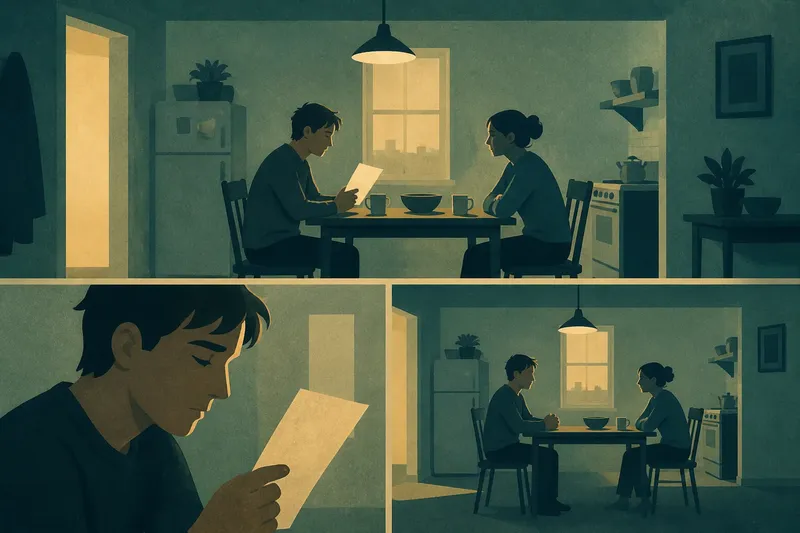
Say you are watching an invented scene in a small kitchen. It begins with both siblings and the table in a wide shot. After one sibling reads a note, the film cuts to a close-up of the reader’s face, then returns to the wide view as the other sibling waits. Your notes might be: the first shot establishes both people; the close-up narrows attention to the reader; the return shows the silence shared across the table. That describes the sequence without claiming to know what the director intended.
Does the camera move or hold still?
Separate movement in the frame from movement of the camera. A person can cross the image while the camera remains fixed. A pan turns the view from side to side; a tilt shifts it up or down. A tracking move carries the camera through space, while a zoom changes magnification without moving the camera itself.
Ask what becomes visible as a move happens. A pan might bring another person into the shot. A tracking move might keep a speaker in view as the background changes. If the camera holds still, a character may enter or leave the image without the viewpoint following. Describe the change first; consider its effect only in context.
A simple analogy helps: framing is like choosing what fits inside a window. The room beyond it has not disappeared, but the view gives some details more attention than others.
How can you read camera framing in a one-room film scene?
What should I note about composition?
Write down which people and major room features share the frame, and where they appear within it. If a person is partly blocked or placed near an edge, note that visible arrangement before guessing at its significance.
How can I tell a camera move from an actor’s movement?
Watch a fixed feature such as a doorframe or window. If it shifts across the image, the camera may be moving; if it stays put while a person crosses, the camera is likely holding its position. A cut can also change the view, so note whether the image changes continuously or jumps to another shot.
Why does a film cut to a close-up?
A close-up makes a face or detail occupy more of the image. It can draw attention to a reaction, but its meaning depends on the surrounding shots, performance, and dialogue.
Do I need to infer the filmmaker’s intention?
No. Record what is visible and when it changes. Treat an interpretation as a possibility, not as a fact, unless the scene gives you clear support.
Which details are worth recording?
Keep a short record of framing decisions. Each observation should lead to a practical choice about what to inspect next, rather than an automatic verdict about meaning.
- If the shot includes the whole room, note the people and landmarks visible; then use that view to establish the scene’s basic geography. If the room is cropped, identify which areas are excluded instead.
- If two speakers share a shot, note whether both faces remain visible; then compare their expressions during the exchange. If one is excluded, check the next shot for that person’s reaction.
- If a close-up appears, record the cut that precedes it and the detail enlarged; then compare what your attention shifts toward. If no meaningful detail is clear, describe the change in shot size without assigning a purpose.
- If the camera pans or tilts, name the feature that enters or leaves the image; then check what the move reveals. If no new information appears, note the movement without treating it as emphasis.
- If the camera tracks through the room, follow a fixed background feature as well as the subject; then decide whether the move changes your view of the space. If the background stays largely unchanged, focus on how the subject is kept in frame.
- If the camera holds while a person moves, note where that person enters or exits the image; then compare the empty frame with the occupied one. If the shot cuts before the change is complete, record the cut rather than filling in what you did not see.
- If a face or object is partly obscured, name what blocks it; then check whether a later shot provides a clearer view. If the film never does, preserve the uncertainty instead of inventing a reason.
For the second viewing, choose one question: what changes when the film cuts closer, or what does a held frame keep visible? A narrow question is easier to answer than a catalogue of every prop and glance. In a one-room film scene, camera framing is most legible when you can point to the exact moment the image changes and say what that change lets you see.